

What Cardiac Drift Says About Your Fitness and Why It Matters More Than Your FTP
Most cyclists are chasing numbers. Whether it’s FTP, VO2 max, PRs. That one Strava segment that's going to be yours this summer. And those numbers matter, don’t get us wrong.
But there's a metric quietly sitting in your TrainingPeaks data that tells you more about what's actually happening inside your engine than almost anything else.
It's called cardiac drift. And once you understand this term, you’ll never overlook your endurance rides again.
What Is Cardiac Drift?
Cardiac drift can reveal a lot about an athlete’s aerobic fitness or aerobic engine and your fatigue resistance capacity.
Let's break it down.
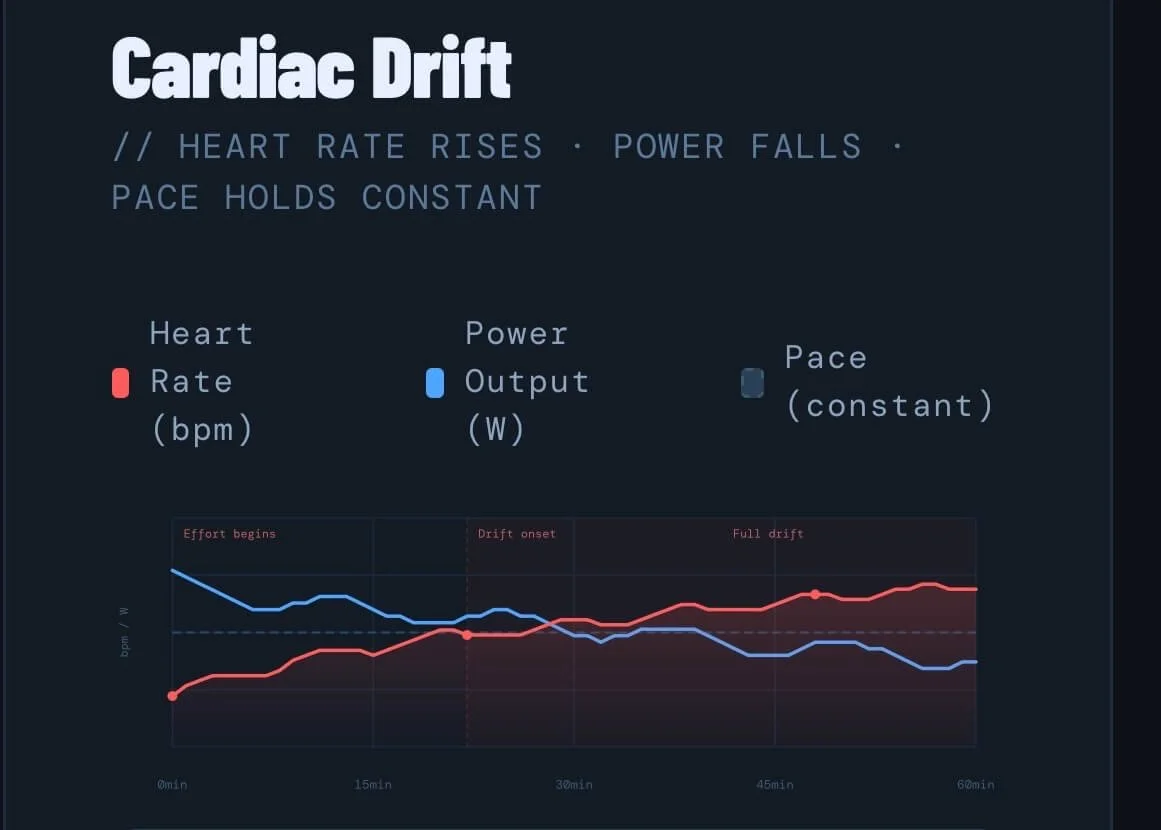
Cardiac drift, also known as aerobic decoupling, happens when your heart rate rises while your power output (watts) stays steady during a longer endurance ride. Or vice versa: your power starts to drop while your heart rate stays the same.
Either way, your internal effort (heart rate) and your external output (power output) are no longer running parallel. Early in the ride everything is in sync. Steady heart rate for the same watts. As the ride goes on, this starts to break down. Your body is working harder and harder to produce the same result it was managing easily an hour ago.
That's a drop in efficiency. And that's exactly what cardiac drift is measuring.
What's Actually Happening Physiologically?
Cardiac drift is the result of one cardiovascular response known as cardiac output and it matters because it’s your heart's ability to deliver oxygenated blood to your working muscles. It is determined by two things: stroke volume (how much blood the heart pumps per beat) and heart rate (how many times it beats per minute). Together they determine your cardiac output, in other words the total volume of blood your heart circulates per minute.
Why does it matter to your riding? During a long steady effort, as fatigue accumulates, stroke volume starts to decrease. In response, your body compensates by increasing heart rate to maintain the same cardiac output. Therefore your system is working harder by increasing your heart rate to maintain the same power output on the bike.
That's the drift.
And many factors are driving this drift: rising core temperature, dehydration, glycogen depletion, loss of blood plasma and cardiovascular fatigue all compounding over the course of a ride. Your body is becoming less efficient than it was at the start of the ride and is working harder… The data shows it.
When your aerobic system is well developed and efficient, the heart can handle these factors without too much compensation. You therefore develop a stronger stroke volume response. As a result, the stroke volume is maintained and the heart rate stays steadier. Your aerobic engine holds up over time. But when the aerobic base still needs work, the drift starts to happen earlier and climbs higher.
The House Analogy and Why It Matters:
This is how we explain it to our athletes and it tends to make everything click. And knowledge is a powerful tool.
Think of your fitness like a house.
Your aerobic base is the foundation. Your FTP is the first floor. Your VO2 max is the ceiling.
Everyone wants to raise the ceiling. But for many, pouring the concrete foundation is not as exciting!
Here's the reality. If your foundation is weak, you cannot build a stable first floor. And you sure can’t push the ceiling higher without the structure underneath supporting it. If your aerobic base is underdeveloped, everything you try to build on top of it becomes harder to sustain and harder to improve.
And here's the part that matters most for cycling performance.
These three levels don't just stack on top of each other, they feed each other. Raise your aerobic base and your FTP improves. Raise your FTP and your VO2 max potential opens up. Raise your VO2 max and it creates more room to push FTP higher. It all works together.
But it starts at the foundation.
How To Measure It:
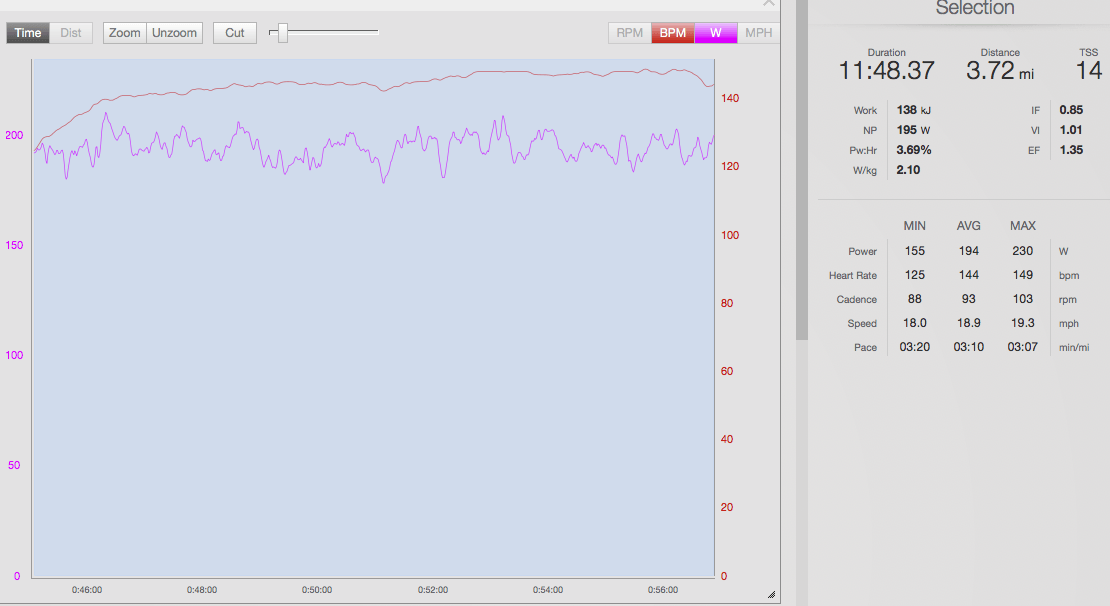
If you're using TrainingPeaks, cardiac drift is referred to as aerobic decoupling and it shows up as PW:HR (Power to Heart Rate ratio). In short, it compares the first half of a steady effort to the second half and gives you a percentage.
Here's how to read it on a relatively steady and long effort:
5% or less: solid aerobic base. Your system is efficient and holds up well over the duration of your ride, the proof is in the pudding.
5–10%: room for improvement. Your base is developing but there's still work to do.
10% or more: something is off. It could be fitness, could be fueling, could be pacing (the effort was likely above aerobic threshold). Maybe you are not recovered from prior workouts or you are covering a little sickness. Worth looking into.
One important note.
This data is only meaningful with a steady effort. Stop-and-go riding, spicy group rides, surges, or variable terrain will skew the numbers. You need a controlled, steady effort - think long endurance ride at a consistent zone 2 pace, to get clean data.
The two biggest factors:
Once you understand your decoupling numbers, there are two main things that move them and worth considering in your training.
1. Training at the right intensity
This is the one most cyclists like to overshoot because we like to go hard!
Building your aerobic base requires training in the true endurance zone. Not tempo. Not "comfortably hard". Not the effort that feels productive because you start to sweat and the legs are burning.
True endurance base work. The effort that for most cyclists seems less productive therefore makes it feels less desirable to train here. It’s that pace where you could hold a full conversation without struggling. The talk test is real.
Training at true endurance intensity stresses stroke volume in a way that higher intensities don't replicate. It's this specific stress (sustained, moderate, aerobic) that drives the adaptations that in results improve your cardiac efficiency over time. When you drift above that zone on endurance days, you shift the training stimulus and you just accumulate more fatigue without reinforcing the aerobic fitness base.
This is one of the hardest things for driven, committed cyclists to execute consistently. The ego wants to push. Every ride that doesn't feel hard enough feels like a wasted opportunity. But the data tells a different story. The athletes who focus on their endurance zone work are the ones whose foundation keeps getting stronger, whose drift numbers keep coming down, and whose FTP and VO2 max follow.
Don’t get us wrong, we still need to work on these other energy systems as well to create a well rounded and performing cyclist…but don’t skip working on your basement, your foundation.
2. Fueling: the one that gets ignored most
Glycogen depletion is one of the biggest drivers of cardiac drift. And it's one of the most controllable factors. And we love the phrase control your controllables.
When carbohydrate stores run low, the body becomes significantly less efficient...there's no gas in the tank. Heart rate climbs, power fades, the drift starts to accelerate. And a lot of cyclists look at that data and think they have a fitness problem when they actually have a fueling problem.
Fueling on long rides isn't optional and shouldn’t be an afterthought. It should be looked at as part of the training regime. Plenty of carbohydrates during longer efforts directly supports your ability to hold efficiency and get clean data from your rides. If you're not fueling adequately, your decoupling numbers will reflect that and you'll be drawing the wrong conclusions from them.
And yes, that means you do have to plan out your fuel (gels, maple syrup, potatoes, gummies). It’s always better to have more snacks than less snacks, because we all have that one friend who likes to add 10 miles to the ride without consulting anyone.
What Improving Your Base Actually Looks Like:
When you commit to building your aerobic foundation consistently, training in the right zones, fueling properly, giving it time, here's what starts to change.
Cardiac drift decreases. You hold efficiency deeper into long efforts. That slow fade that used to start around hour two starts showing up later, or not at all. You recover better between hard days. You handle more training load without constantly feeling worn down. And then the numbers you actually care about start moving too.
FTP improves. The power duration curve extends. VO2 max opens up. Performance on long gravel events, climbs, and hard group rides starts reflecting the work you've been putting in.
And trust us, this doesn't happen overnight. Building a real aerobic base takes months of consistent, disciplined work. But the athletes who do it; who actually pour the concrete instead of just trying to raise the ceiling — are the ones who keep seeing performance gains on the bike.
Do the basics and do them well.
What To Do With This Information
Next time you head out for a longer endurance ride, keep the effort steady, fuel properly, and check your PW:HR afterward in TrainingPeaks.
If the number is higher than you expected, that's not a failure. That's data. It tells you whether you need to build more aerobic base, clean up your fueling, or work on your pacing.
If you're not sure how to interpret what you're seeing or whether your training is actually building the foundation it needs to, that's exactly the kind of conversation we have with our athletes every day.
Want to know what your data is actually telling you? That’s what we’re here for!
Cardiac drift can be one of the most useful metrics in cycling, if you know how to use it.
If you've been training consistently but feel like you are starting to plateau or you're not sure whether your endurance work is actually building something solid, this is where that answer starts to show up.
Book a free 15-minute discovery call. We'll look at your data, walk through what it's telling us, and talk about what adjustments would actually help improve your performance, not just maintain it. Working with a cycling coach might be the performance edge you need.
Because afterall, your heart rate is telling you something, are you listening?